Last updated: November 29, 2026
Quick answer: 30 days is a common starting point for how long should a home sale contingency period be, but the right deadline should match the listing timeline, the expected closing date, and the seller’s flexibility. In many cases, the right deadline is tied to the listing timeline and the expected closing date, not a fixed rule. A real estate agent can help match the contingency deadline to the purchase contract and the seller’s flexibility.
Key takeaways
- The right deadline is the one that fits the actual sale timeline, not the one that sounds safest on paper.
- A short period can protect the seller, but it can also force the buyer into a rushed sale.
- A longer period gives breathing room, yet it can make the offer less attractive in a tight market.
- The deadline should line up with the listing agreement, the expected closing date, and any financing deadlines in the purchase contract.
- If the numbers do not fit cleanly, the safer move is to discuss the timing before signing, not after.
How long should the home sale contingency period be?
A home sale contingency period should be long enough to cover the time it usually takes to list a home and reach closing, but short enough that the seller does not feel stuck. That balance is the whole point of the deadline.
There is no single number that works for every buyer. A cleaner way to think about it is in relation to the closing date on the home being purchased and the listing timeline for the home being sold. If the current home still needs photos, showings, an offer, inspection, and closing, a very short window can create pressure that no one can fix later.
Because the market matters, the period should also fit the market. In a buyer-friendly market, a seller may accept a longer contingency because offers can take more time to secure; a real estate agent can help confirm that timing, and the National Association of Realtors has guidance on how market conditions affect negotiations. In a faster market, a long deadline can weaken the offer because the seller has to wait through an open-ended delay.
A useful rule is simple: choose the shortest period that still gives a realistic path to sell the home. That keeps the purchase contract credible and reduces the chance that the deal hangs around past the point where either side wants it.
What affects the deadline?
The deadline depends on the home, the market, and the way the two contracts fit together. A home that is already listed with activity has a very different timing problem from a home that still needs to be prepared, priced, and launched.

The first factor is the listing agreement. If the home is not yet on the market, the contingency period needs room for that step before the first showing even happens. A buyer who asks for a tight deadline while the seller still has 10 to 14 days of prep work ahead is asking for a mismatch.
The second factor is the purchase contract on the new home. If the closing date on that contract is close, the contingency period has to fit inside it or the buyer risks missing the deal. If the closing can move, the seller may have more room to wait.
The third factor is seller flexibility. Some sellers can live with a 30-day wait. Others need a faster path because they are already under contract on another property. That is why the same deadline can feel reasonable in one deal and impossible in another.
The fourth factor is the real estate agent’s read on the local market. If homes are moving quickly, a longer contingency can look weak. If homes are sitting, the same deadline may be normal. The Consumer Financial Protection Bureau also recommends reviewing timing details carefully before signing, especially when a contract depends on another sale.
How do you choose the right length?
The right length comes from working backward from the closing date and forward from the listing timeline. That is the cleanest way to avoid a deadline that looks neat on paper but fails in the real world.
-
Set the target closing date for the new home.
Put the date in the purchase contract first, then count back to see how much time is actually available. If the closing is 45 days out, the contingency cannot consume all 45 days and still leave room for paperwork. -
Map the selling steps for the current home.
Include listing prep, photos, showings, offer review, inspection, and closing. If even one of those steps is likely to take a week or more, the period needs a cushion. -
Ask the real estate agent what is realistic in the current market.
A realistic deadline is one that matches how long similar homes are taking to sell, not how fast the buyer hopes it will happen. If the market has been slow for 60 days, a tiny window is a gamble. -
Compare the contingency deadline with the purchase contract.
The deadline should give enough time to sell without forcing a rushed move into the new home. If the two contracts leave no overlap, the buyer may be exposed to a gap. -
Choose the shortest deadline that still protects both sides.
Shorter deadlines are usually cleaner for the seller, but only if they still allow a fair chance to complete the sale. A deadline that is too short can make the whole offer look unstable.
This process is less about picking a magic number and more about avoiding a bad fit. A buyer who guesses often ends up either too rushed or too loose.
What works in different markets?
The best deadline can change with market conditions, because the same number can send very different signals. A 30-day contingency may feel normal in one place and too slow in another.
| Market setting | Shorter deadline | Longer deadline | Main trade-off |
|---|---|---|---|
| Seller-leaning market | Looks stronger to the seller | Can weaken the offer | Strength versus breathing room |
| Buyer-leaning market | May be too tight to sell well | More realistic for the buyer | Flexibility versus speed |
| Home already listed and active | Easier to justify | May still be acceptable | Current momentum versus delay |
| Home not yet listed | Often too short | More workable | Readiness versus pressure |
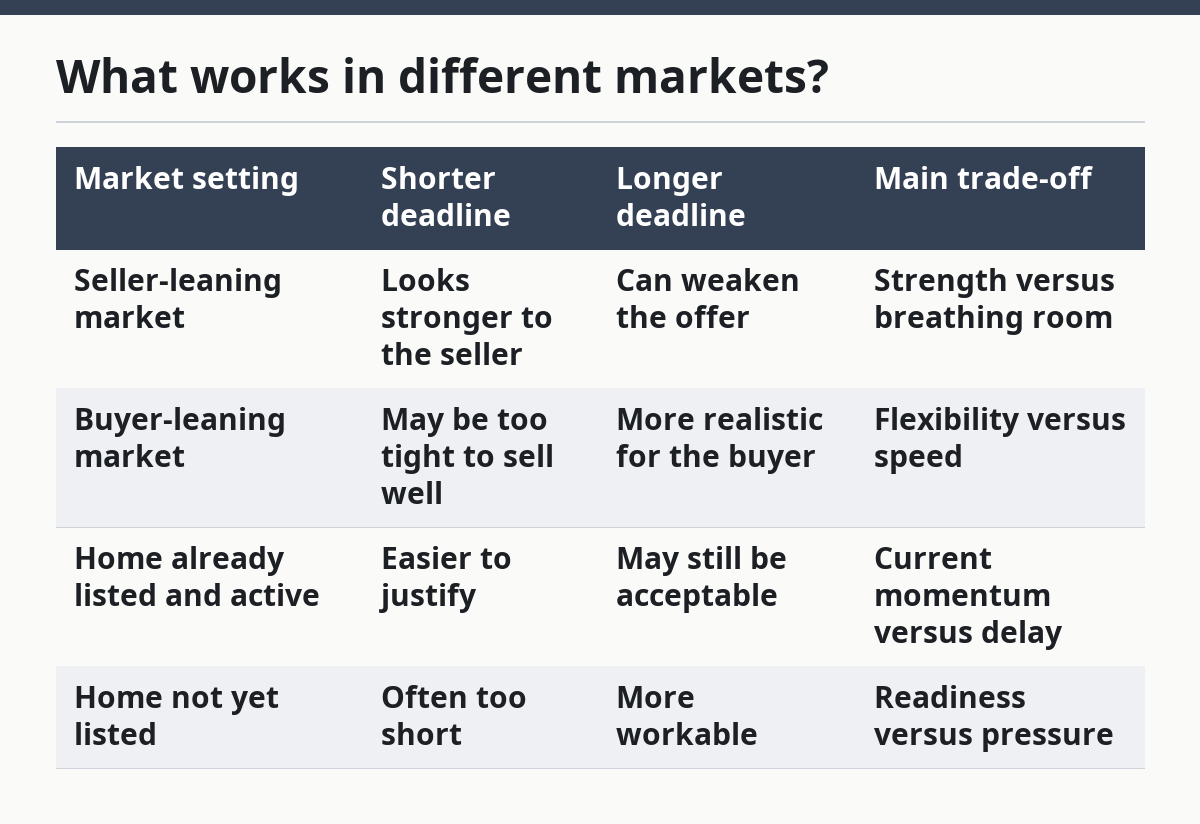
The point of the table is not to turn timing into a formula. It is to show that the same contingency period can be smart in one deal and clumsy in another.
A buyer who already has a live listing with showings may be able to support a shorter deadline. A buyer who still needs to launch the home should resist pretending the process will move in 7 days just because that sounds tidy.
What does a too-short or too-long period cost?
A too-short period can cost the buyer the whole deal, while a too-long period can cost the seller confidence in the offer. Both problems show up before closing, not after.
A short deadline can make it hard to get the home sold on time. If the buyer has not yet secured an offer on the current house, the purchase contract may become shaky fast. In that situation, it is wise to consult a real estate professional or attorney about the timing before signing. That can push the buyer into a worse position, such as accepting a lower price or rushing decisions that should take a few more days.
A long deadline has a different cost. It can make the seller wait while other offers move on, and it can make the contract feel uncertain. In a market where timing matters, a long contingency can make the offer look like a backup plan instead of a serious purchase.
A period that is too ordinary for the market may still be too long for the seller’s own deadline or too short for a home that needs repairs before listing. That is why the number alone is never the whole answer.
The safer approach is to use the deadline as a planning tool, not as a guess. If the period does not fit the listing timeline and the closing date at the same time, it needs adjustment before anyone signs.
How should the deadline be written into the contract?
The deadline should be written clearly in the purchase contract so both sides know what happens by the last day. Ambiguous language creates avoidable fights, and those fights often start with a date that was never pinned down.
The written deadline should name the day the contingency ends and make clear whether that day is tied to a specific event or a simple calendar count. If the timing depends on the seller’s home going under contract, that should be stated in plain language. If it ends after a set number of days, that number should be easy to find.
A strong contract also leaves less room for confusion about the closing date. If the home sale contingency period is shorter than the time needed to finish the sale, the buyer is exposed to a gap. If it is longer than needed, the seller may see the offer as uncertain.
A real estate agent should review the language before it is signed, because small timing mistakes can create large problems later. The issue is not just the number of days. It is whether the deadline matches the actual path from listing agreement to closing.
When is a longer period a bad idea?
A longer period is a bad idea when the seller needs speed, when the market is hot, or when the buyer already has a tight purchase contract. In those cases, extra days can make the offer less competitive without adding much real protection.
It is also a bad fit when the current home is already in a strong position to sell quickly. If the listing is active and likely to move fast, asking for a very long window can look cautious in a way that weakens the offer. The seller may choose a cleaner deal instead.
The same caution applies when the buyer is not prepared to list right away. A long deadline can hide a weak plan. It does not fix pricing, staging, or a poor launch schedule.
A better choice is to match the period to the actual sale pace. If the current home needs time, say so in the contract and choose a deadline that reflects reality. If the timeline is already tight, do not pretend that more days will make the math easier.
What is a typical home sale contingency period?
A typical home sale contingency period is long enough to cover a realistic sale timeline, not just the paperwork on one page. The right length depends on how far along the current home is, how active the market is, and how the closing date lines up with the new purchase contract. On this page, 30 days is the common starting point, but it is only a starting point.
Can the contingency period be extended?
Yes, the contingency period can sometimes be extended if both sides agree. That said, an extension is not a fix for a deadline that was unrealistic from the start. It usually works best when the seller is still comfortable waiting and the buyer can show progress on the current home. If the timing is unclear, consult a real estate professional or attorney before relying on an extension.

What happens when the contingency deadline passes?
When the contingency deadline passes, the contract follows whatever deadline language was written into it. If the buyer has not met the condition by then, the deal can be at risk. The exact result depends on the purchase contract, which is why the deadline should be clear before anyone signs.
For a deeper overview of the broader setup, see the home sale contingency period guidance above and the timing steps in this article. For related background, the market factors section explains how listing time, closing dates, and seller flexibility shape the deadline.
Drafted with AI; not yet reviewed by a person.