Last updated: November 29, 2026
Quick answer: sellers usually evaluate a home sale contingency by weighing 4 things — sale status, timing, financing, and the chance the deal closes on schedule. In multiple offers, the seller and listing agent compare the contingency against price, financing strength, timing, and the odds the sale closes on schedule. A home sale contingency can still win, but only when the rest of the offer makes the closing feel dependable. How do sellers evaluate a home sale contingency in multiple offers? They usually treat it as a risk trade-off, and you can see the same basic logic in home sale contingency, seller contingencies, and multiple offers discussions.
Key takeaways
- A home sale contingency tells the seller that your purchase depends on selling another home first.
- In a multiple-offer pile, sellers look at the chance of delay, not just the offer price.
- Cash, strong financing, and a clean timeline can outweigh a higher but fragile offer.
- Backup offers matter because they give the seller a fallback if the first buyer’s home does not sell.
- The weakest part of a contingent offer is usually timing, since two closings must line up.
What does a home sale contingency mean to a seller?
A home sale contingency means the seller may have to wait for your current home to sell before your purchase can close. To a seller, that means the deal may depend on a second transaction that they do not control.
That is why sellers read the contingency as risk. If your home is already under contract, the risk is lower. If it is not listed yet, or if it has been sitting for 30 days or more, the seller may see the offer as uncertain.
The listing agent usually looks at three things right away: how far along your sale is, how much time your contract gives you, and whether the seller can keep showing the home. A seller does not just ask, “Is this offer high?” The real question is, “How likely is this offer to reach closing without a late twist?”
This is the right place to start if you want the full framework for the contingency itself: home sale contingency. That bigger topic explains the clause; this page explains how a seller reads it against other offers.
How do sellers compare it with other offers?
Sellers compare a home sale contingency against the whole package, not one line in the offer. They weigh price, financing, closing date, inspection terms, and the chance of the sale falling apart before escrow ends.
Here is the basic trade-off sellers are making:
| Offer feature | What the seller sees | Why it matters in multiple offers |
|---|---|---|
| Higher price with home sale contingency | More money, but more uncertainty | The seller may prefer a lower but cleaner offer if they want speed |
| Lower price without contingency | Less money, less risk | A faster, surer close can be worth more than extra dollars |
| Strong financing with contingency | Better odds the loan part closes | Helps, but does not remove the risk of your first home not selling |
| Long closing timeline | More time for your sale to finish | Can help if the seller can wait, hurt if they want a quick move |
| Backup offer available | Seller has a fallback | Makes the contingent offer easier to accept |
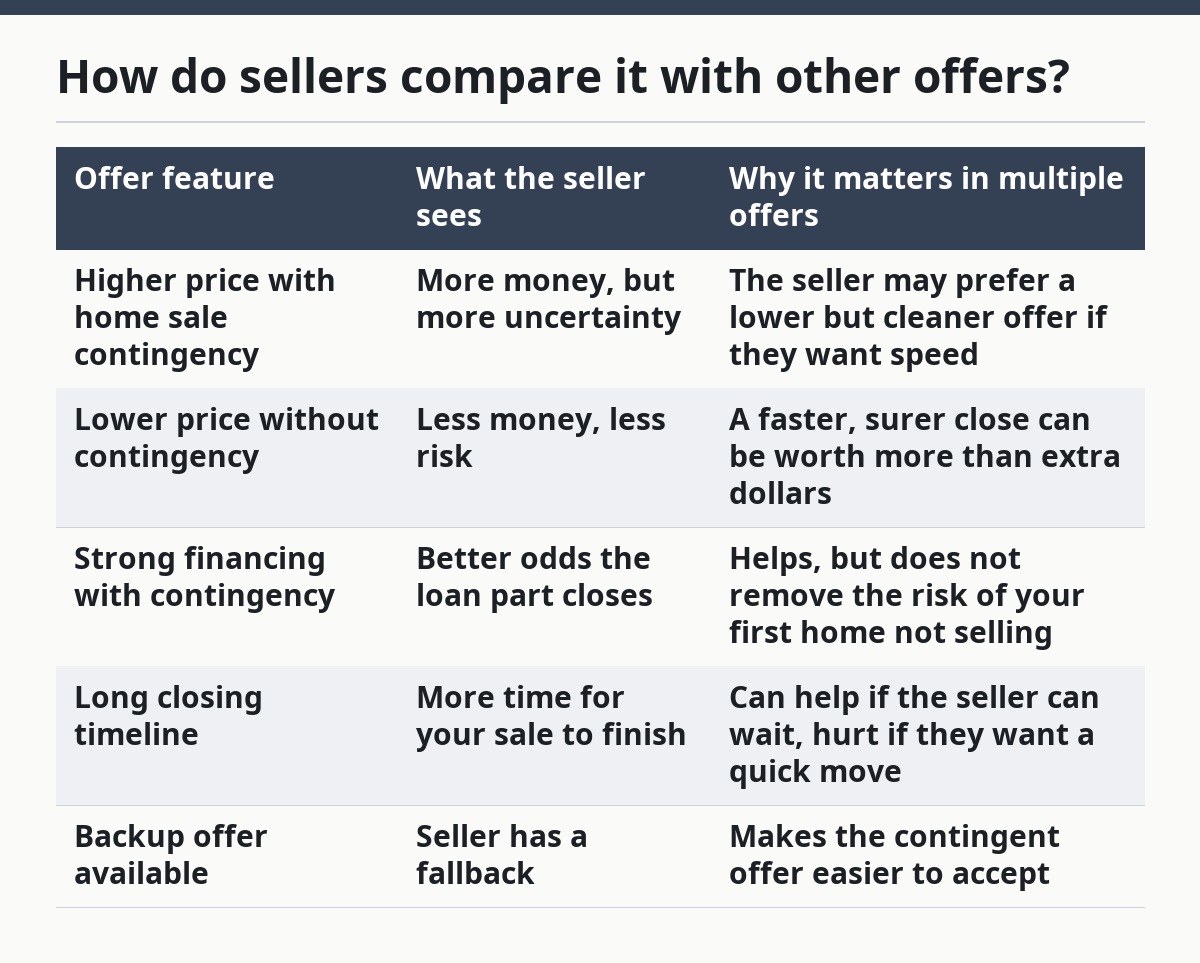
A seller often thinks in terms of “net certainty.” If one offer is $10,000 higher but has a home sale contingency and another is slightly lower with no contingency, the seller may favor the cleaner path. That does not mean the contingent offer loses automatically. It means the seller is buying down the chance of a missed closing.
The listing agent also looks at whether the seller can accept a backup offer. A backup offer gives the seller a second line of defense if the first buyer’s home does not sell on time. That can make a contingent offer easier to sign because the seller is not locked into only one outcome.
What risk makes sellers hesitate?
Sellers hesitate when the contingency could delay closing, trigger extra negotiations, or force the home back on the market. The main problem is not the clause itself. The problem is the chain reaction it can cause.
A home sale contingency can create at least four seller concerns:
- The buyer’s home may not sell quickly. If the home is priced too high or needs work, the seller’s closing date becomes shaky.
- The buyer may need more time than the seller can spare. A seller who needs to move in 21 days will care a lot about timing.
- The sale may fall through after other offers are gone. Once the seller accepts a contingent offer, they may lose better alternatives.
- The seller may face two moving schedules at once. If the buyer’s sale closes late, the seller’s own next purchase can get messy.
This is why a listing agent will often ask for proof that the buyer’s home is market-ready. A home already under contract usually looks better than a home that is not listed. A home with a short expected marketing window can still be risky if the local market is slow.
This is also where a contingent offer is not a good fit for every buyer. If your first home is not listed, or if you cannot tolerate a tight 2- to 4-week timing squeeze, the offer may look too uncertain for a seller in a bidding war.
What does a seller or listing agent check first?
A seller or listing agent checks the buyer’s sale status, the closing date, and whether the rest of the offer is clean. Those three items usually tell the whole story faster than the price does.
A practical review often goes like this:
- Check whether the buyer’s home is listed. A listed home signals the buyer has started the sale process. A not-yet-listed home adds uncertainty.
- Check whether it is already under contract. A signed contract on the buyer’s home usually makes the chain look more real than a future hope.
- Check the time allowed in the contingency. A shorter window can help the seller, while a long open-ended clause can scare them off.
- Check the closing date on the purchase offer. If the seller needs to move fast, even a strong price may not be enough.
- Check the financing strength behind the offer. A home sale contingency does not fix weak financing. Sellers still want a lender-approved buyer, not just a hopeful one.
- Check whether backup offers are allowed or likely. A backup offer can give the seller a safety net if the first deal stalls.
In a multiple-offer setting, the listing agent is often looking for the offer that will get to the finish line with the fewest moving parts. A tidy timeline and a buyer who already has a signed contract on their own home can make a contingent offer feel much more solid.
For a buyer, that means the contingency is only one part of the picture. The seller is asking whether the home sale will likely close before the offer expires, before the contract drags, and before the next family of surprises shows up.
Why does financing strength still matter?
Financing strength still matters because a home sale contingency does not replace loan risk. A seller can have a buyer whose current home is under contract and still face trouble if the new mortgage is shaky.
That is why sellers often compare contingent offers with financing terms side by side. A buyer with a solid down payment, a lender’s preapproval, and a clear closing plan usually looks better than a buyer with weak financing and a bigger number on paper. The seller wants two things to line up: the old home must sell, and the new loan must close.
The Consumer Financial Protection Bureau explains preapproval in a way that helps here, because it shows why sellers care about lender backing at the same time as the contingency. A preapproval letter is not the same as a finished loan, but it does give the seller another sign that the buyer is not guessing. See also the CFPB’s guidance on mortgage preapproval and loan preapproval.
This is also why some sellers prefer one strong, simple offer over several complicated ones. A $500,000 offer with two loose ends may feel worse than a $490,000 offer with one clean path to closing. The exact numbers change, but the logic does not.
When does a backup offer help?
A backup offer helps when the seller wants a second path if the first buyer’s home sale stalls. It does not remove the contingency, but it lowers the seller’s fear of getting stuck with only one fragile deal.
Backup offers matter most when the seller expects a delay of 14 to 30 days or more. If the first contract depends on the buyer’s home selling, the seller may feel better knowing another buyer is waiting in line. That can make the first contingent offer easier to accept, especially when the market is active and other buyers are still around.
A backup offer can also change the seller’s negotiating posture. Instead of seeing the contingent buyer as the only option, the seller can treat that offer as one path among two. That can make the seller more willing to accept a slightly weaker price if the rest of the terms are clean.
Still, a backup offer is not magic. If the seller needs to close in a very short window, or if the buyer’s home is not moving, the fallback does not solve the core timing problem. It just reduces the cost of saying yes.
What is the seller’s final decision based on?
The seller’s final decision is based on certainty, timing, and price in that order when the market is competitive. In a multiple-offer situation, the highest number may not win if the path to closing is messy.
A seller may choose the home sale contingency if:
- the buyer’s current home is already under contract,
- the timing fits the seller’s move,
- the rest of the offer is clean,
- and the backup plan gives the seller some protection.
A seller may reject it if:
- the buyer’s home is not listed,
- the timing is open-ended,
- the seller needs a fast close,
- or another offer has fewer moving parts.
That is the real framework. Sellers are not judging the clause in a vacuum. They are asking whether the offer can survive the next few weeks without surprise.
A contingent offer is wrong for sellers who need speed more than price, and it is weak in a bidding war where every extra step can break the chain. It can still work, but only when the buyer’s side already looks close to done.
How do sellers compare contingent offers?
Sellers compare contingent offers by looking at which one is most likely to close on time with the least risk. They usually examine the buyer’s home status, the contingency deadline, the closing date, and the strength of the rest of the offer.
If two offers both have a home sale contingency, the seller may favor the one with a house already under contract or the one with a shorter, cleaner timeline. Price still matters, but certainty tends to decide close calls.
What makes a contingent offer more acceptable?
A contingent offer is more acceptable when the buyer’s home is already under contract, the timeline is short, and the rest of the deal looks orderly. A seller feels better when the contingency has fewer unknowns attached to it.
A clear closing date, solid financing, and a backup offer on the table can all improve the seller’s comfort level. The main goal is to show that the buyer’s sale is not a loose plan but a deal that is already moving toward closing.
Drafted with AI; not yet reviewed by a person.