Last updated: November 29, 2026
Quick Answer: a kick-out clause gives the seller a set notice period, often 24 or 48 hours, to move on if the buyer does not remove the home sale contingency. In a home sale contingency, the question is simple: what does a kick-out clause mean in a home sale contingency, and who has to act before the deadline? It is a seller-protection term inside the purchase agreement, and the key date is the notice period the seller gives before the original deal can be pushed aside.
Key takeaways
- A kick-out clause gives the seller a second chance without fully canceling the first contract.
- The buyer usually gets a short notice period to decide whether to move forward without the home sale contingency.
- A backup offer can sit in the wings while the first buyer still has a chance to respond.
- This clause helps sellers, but it can put pressure on buyers who have not sold their own home yet.
- The clause matters most when the purchase agreement spells out who must act, how notice is delivered, and what happens next.
What is a kick-out clause in plain English?
A kick-out clause is the seller’s escape hatch in a home sale contingency. It means the seller can accept another offer if the first buyer has not sold their current home by the deadline in the contract.
Think of it as a conditional yes, not a locked-in yes. The original buyer still has the first shot, but the seller is not stuck waiting forever. The clause turns the agreement into a live 2-step process: keep the deal open, then give notice if a better offer arrives.
This matters because a home sale contingency can slow a sale. If the buyer still owns another house, the seller may not want to wait through an open-ended delay. A kick-out clause gives the seller a way to keep the listing active while protecting the first buyer for a set period.
The clause does not end the deal by itself. It only becomes a problem after a new offer appears and the seller uses the notice period written into the contract. That is why the exact wording in the purchase agreement matters so much.
How does a kick-out clause work step by step?
A kick-out clause works through a short chain of events: offer, notice, response, and either removal or exit. The whole point is to give the buyer a last chance before the seller moves on.

-
The buyer makes an offer with a home sale contingency.
The contract says the buyer’s purchase depends on selling an existing home. -
The seller accepts, but keeps the right to accept another offer.
That right is the kick-out clause, and it is written into the purchase agreement from the start. -
A better offer comes in while the first deal is still open.
The seller does not have to wait indefinitely for the first buyer’s home to sell. -
The seller sends notice to the buyer.
The notice period begins here, and the buyer must decide what to do before the clock runs out. -
The buyer either removes the contingency or steps aside.
If the buyer can move forward without waiting on a home sale, the deal stays alive. If not, the seller can move to the backup offer.
That is the core sequence. The clause is not about drama or leverage; it is about timing and clean paperwork. If the notice period is vague, the whole clause becomes harder to use, which is why careful drafting matters.
What can the buyer do after notice?
The buyer usually has 2 main options after notice: remove the home sale contingency or let the contract end. The exact response depends on what the purchase agreement says, but the logic is the same.
If the buyer can sell fast or has another source of funds, the buyer may choose to remove the contingency and keep the house. That usually means the buyer is ready to close without waiting for the old home to sell.
If the buyer cannot do that, the buyer may walk away and lose the home. That is the hard part of a kick-out clause: it creates pressure when the buyer’s own sale is still uncertain.
This is where the contingency removal deadline matters. The seller is not waiting for a general promise to do better later. The seller is waiting for a clear answer within the notice period.
A buyer should also check whether the contract requires written notice, how notice is delivered, and whether the clock runs in calendar days or business days. Those details can change how much time the buyer really has to react. A clause that sounds simple can become a race against a 24-hour or 48-hour notice window if the contract says so. For buyers, it is wise to review the contract closely and consult a real estate professional or attorney before treating the home as secured; the Consumer Financial Protection Bureau and National Association of Realtors both stress that contract terms and contingency deadlines matter. CFPB, NAR
How does a backup offer fit in?
A backup offer gives the seller a second contract to fall back on if the first buyer does not remove the contingency. It is the cleanest match for a kick-out clause because the seller already has another buyer lined up.
Here is the difference at a glance:
| Topic | Kick-out clause | Backup offer |
|---|---|---|
| Role | Gives the seller a right to move on if the first buyer cannot perform | Gives the seller another buyer ready if the first deal falls apart |
| Timing | Works while the first contract is still alive | Waits behind the first contract |
| Pressure point | Forces the first buyer to answer by the notice period | Creates a ready next step for the seller |
| Result | The first buyer may stay in the deal or be replaced | The backup buyer may become the main buyer |
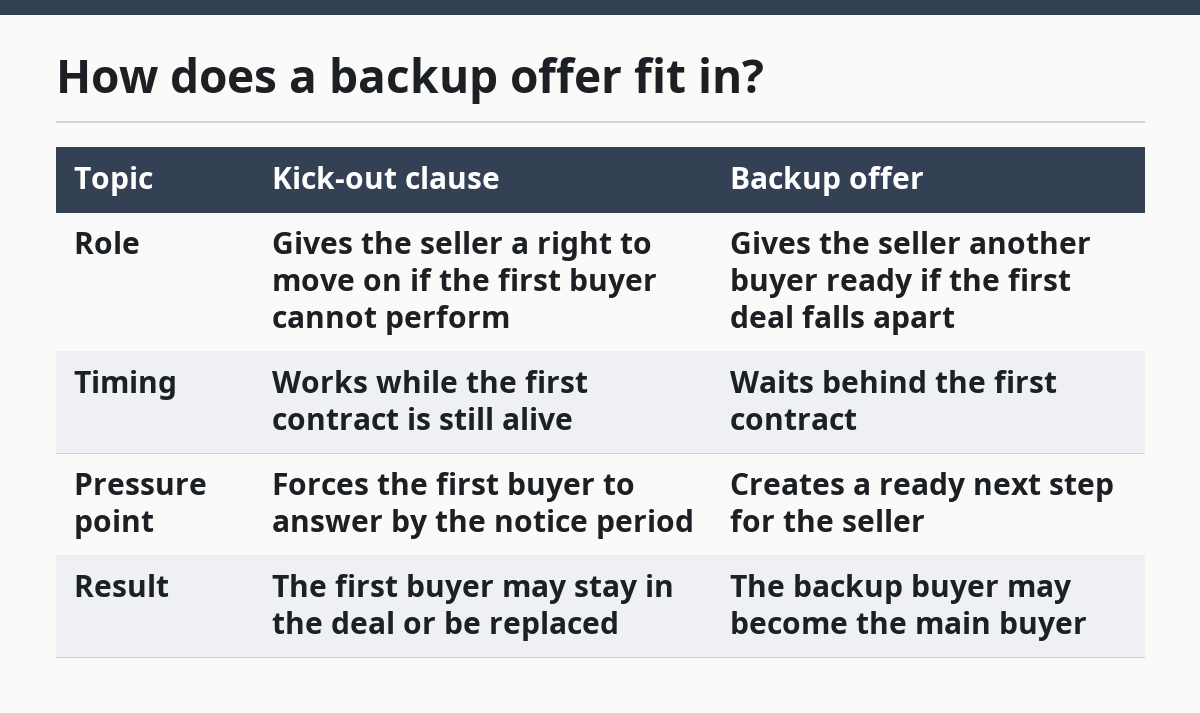
The seller likes this setup because it reduces dead time. The first buyer still has a chance, but the seller is not stuck with a single path. The buyer should understand that a backup offer does not always mean the original deal is dead; it may mean the seller has a second lane ready.
A common mistake is assuming a backup offer automatically cancels the first contract. It does not. The kick-out clause is what lets the seller shift gears after notice and after the buyer fails to remove the contingency.
What should sellers watch for?
Sellers should watch for the notice period, the exact wording of the contingency removal deadline, and any limits on how the kick-out clause can be used. Those 3 items decide whether the clause is helpful or just a line in the contract.

The biggest seller mistake is waiting too long to act. If a backup offer arrives and the seller does not send notice correctly, the original buyer may keep the contract alive. That can leave the seller tied up again, even with another interested buyer on the table.
Another mistake is accepting a weakly written clause. If the purchase agreement does not say how notice must be given, the seller can end up arguing about timing instead of moving the sale forward. A clause that is supposed to protect the seller can turn into a dispute over a simple email or phone call.
Sellers should also know what this clause does not do. It does not guarantee a higher price, and it does not force the original buyer to close. It only gives the seller a path to keep the home active and respond to a better offer without waiting forever.
If the broader structure of the deal still feels unclear, the home sale contingency hub explains the larger setup and how this clause fits inside it.
When does a kick-out clause help, and when does it hurt?
A kick-out clause helps when the seller wants flexibility and the first buyer’s home sale is uncertain. It hurts the buyer when that buyer needs more time than the notice period allows.
This clause is useful in a market where sellers want to keep moving. It gives the seller a way to accept an offer without locking the home off the market for an unknown stretch. It also gives the seller a chance to use a backup offer if the first buyer cannot perform.
The downside is obvious on the buyer’s side. A buyer who still has to sell another home may feel boxed in by the deadline. If the buyer cannot remove the contingency fast enough, the house can be lost even after an accepted offer.
That is why this clause is not ideal for every buyer. It is a poor fit for someone who needs a long runway, has not listed the old home yet, or cannot cover the purchase without the sale proceeds. In those cases, the clause can turn a hopeful deal into a race the buyer may not win.
For sellers, the clause is usually a practical protection. For buyers, it is a warning to read the contract closely before treating the home as secured.
What are the most common mistakes with a kick-out clause?
The most common mistakes are missing the notice deadline, misunderstanding the response options, and assuming a backup offer changes the first contract on its own. Each one can cost time, leverage, or the house itself.

A buyer mistake is waiting until the last hour to decide. If the notice period is short, that delay can end the deal before financing, closing, or a home sale is ready. A better move is to decide as soon as the notice arrives and check whether the contingency can actually be removed.
A seller mistake is using the clause loosely. If the seller acts without following the purchase agreement, the buyer may push back and keep the contract alive. The seller needs the notice to be clear and consistent with the contract language.
Another mistake is confusing a kick-out clause with a full cancellation right. It is not a free pass to end the deal any time a better offer appears. It only works under the terms already written into the agreement.
Because misunderstandings can create deadline problems, both sides should read the notice period, check the contingency removal deadline, and know what happens if the buyer says yes or no. The clause is small, but the consequences are not. For contract timing and contingency basics, see the CFPB and NAR.
Does a kick-out clause let the seller keep marketing the home?
Yes, a kick-out clause usually lets the seller keep marketing the home, but only if the purchase agreement allows it. The seller can often accept a backup offer while the first buyer still has a chance to remove the home sale contingency.
That does not mean the seller can ignore the original contract. The first buyer still has rights under the agreement until the notice period ends or the contingency is removed. The clause is a protection, not a blank check.
How much notice does a buyer get under a kick-out clause?
The buyer gets whatever notice period the purchase agreement sets. That time frame is often short in practice, so the exact wording matters more than the label.
The contract should spell out how notice is delivered and when the clock starts. If those details are unclear, the buyer may have less practical time than expected to decide whether to remove the contingency.
Can a seller accept a backup offer with a kick-out clause in place?
Yes, a seller can usually accept a backup offer if the contract gives that right. The backup offer sits behind the first deal until the buyer either removes the home sale contingency or fails to do so within the notice period.
That is the main seller protection built into the clause. It keeps the listing from going stale while still giving the first buyer a fair chance to stay in the deal.
Drafted with AI; not yet reviewed by a person.