Last updated: November 29, 2026
Quick Answer: If your home does not sell before the home sale contingency deadline, the contract usually reaches one of 3 outcomes: an extension, a seller notice, or termination under the contract terms. What happens next depends on the exact purchase contract, whether there is a backup offer, and whether either side acts before the clock runs out. This article explains what happens if your home doesn’t sell before the contingency deadline and why the answer depends on the contract.
Key Takeaways
- The deadline shifts the deal from waiting to action.
- The buyer should speak with the lender, the agent, and the other side before the deadline.
- The deadline can often be extended if both sides agree in writing.
- If the seller sends a seller notice, the buyer usually has a short window to respond or the contract may end.
What changes on the deadline?
The home sale contingency deadline turns the home sale contingency from “waiting” into “act now.” If the buyer has not sold the old home by that date, the purchase contract does not sit there forever; it usually gives the seller a clear point to demand a choice.

Therefore, the practical result is simple: one side can push for a deadline extension, one side can walk away, or both sides can keep negotiating. The home sale contingency is not a soft suggestion. It is a contract term tied to dates, notices, and next steps, and missing the date can change the deal fast.
A buyer who is juggling a home sale contingency and a mortgage approval should treat the deadline as a professional advice point; consult a real estate agent, lender, or attorney about the contract terms. A seller may have been off the market for 2 weeks or 2 months already and may want the home back in active showing status. If a backup offer exists, that can raise the pressure even more because another buyer is already waiting in line.
This is also the point where a small wording difference matters. Some contracts give the buyer a chance to remove the contingency, while others let the seller issue a seller notice and start a short countdown. The exact language in the purchase contract controls the result, not the general idea of a contingency.
What should the buyer do first?
The buyer should talk to the lender, the agent, and the other side before the deadline hits. The first task is not hope; it is to find out whether the old home can close, whether a deadline extension is realistic, and whether the current contract gives the buyer any room.

A good order of operations is below.
- Check the purchase contract and the home sale contingency date. Find the exact deadline and any notice language, because a 1-day miss can matter just as much as a 1-week miss if the contract is strict.
- Ask the listing agent or buyer’s agent what the seller wants. If the seller is waiting on a move, another contract, or a backup offer, the response may come fast.
- Call the lender about rate lock timing. If the mortgage rate lock is close to expiring, the buyer needs to know whether the lock can be extended and what that does to the timeline. The Consumer Financial Protection Bureau explains rate locks on its website.
- Decide whether to request a deadline extension or let the deal end. A written extension is the cleanest path if the seller agrees; silence is risky because the contract does not extend itself.
- Get every response in writing. A text message is not the same as a signed amendment when money and closing dates are on the line.
As a result, the goal here is not to stall for 30 more days without a plan. The goal is to keep the purchase contract alive only if the old home sale has a real path to closing.
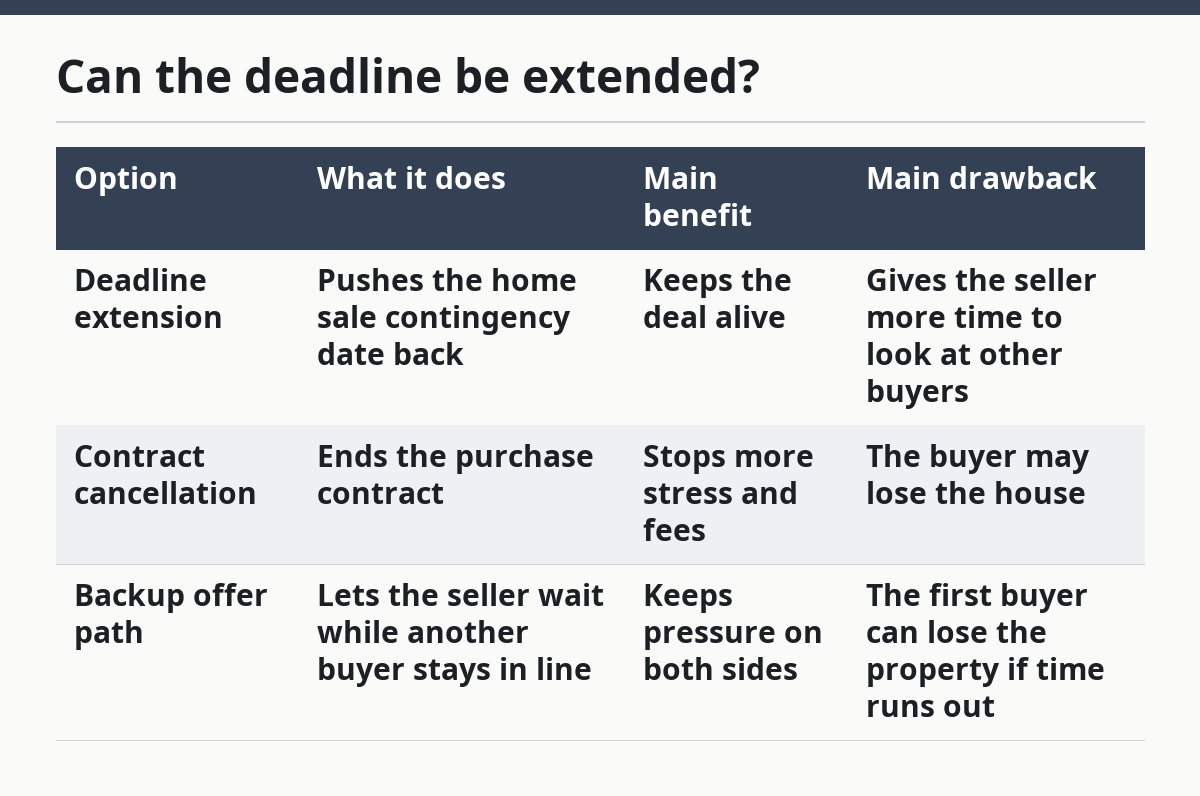
Can the deadline be extended?
Yes, the deadline can often be extended if both sides agree in writing. A deadline extension is the cleanest fix when the old home is close to selling but not quite there yet.
However, the hard part is timing. A seller may say yes to a short extension of a few days or a week, then say no if the buyer still cannot show progress. The buyer should not assume an extension will appear just because the first deadline passed.
A written extension should spell out the new date, not just say “more time.” If the contract uses a seller notice, the extension may also need to answer that notice before the stated window closes. The exact form matters because one unsigned promise can be worthless later.
| Option | What it does | Main benefit | Main drawback |
|---|---|---|---|
| Deadline extension | Pushes the home sale contingency date back | Keeps the deal alive | Gives the seller more time to look at other buyers |
| Contract cancellation | Ends the purchase contract | Stops more stress and fees | The buyer may lose the house |
| Backup offer path | Lets the seller wait while another buyer stays in line | Keeps pressure on both sides | The first buyer can lose the property if time runs out |
A deadline extension is best for a buyer who is close to selling and has lender approval moving forward. It is not a fix for a home that has sat unsold with no serious interest. In that case, the seller may see the extension as a delay tactic, not a real plan.
What if the seller sends a notice?
If the seller sends a seller notice, the buyer usually has a short window to act or the contract may end. That notice is the seller’s way of saying the clock now means something.

Because of that, a notice changes the stakes because it forces a choice. The buyer may need to remove the home sale contingency, ask for a deadline extension, or accept that the purchase contract can be cancelled under its own terms. This is where missing one email or one call can cost the deal.
The buyer should read the notice carefully for three things: the response deadline, the required form of response, and whether the seller is asking for a release or a new date. A notice that gives 24 hours is very different from one that gives 3 days. The contract language controls the window.
If there is a backup offer, the seller may be ready to move on quickly. That does not mean the buyer has no options, but it does mean hesitation can be expensive. A buyer who needs more time should say so clearly and in writing, then back it up with evidence that the old home is moving toward closing.
How does rate lock timing change the pressure?
Rate lock timing can make a missed deadline much worse because the mortgage clock may not wait for the house sale. A rate lock is tied to the loan timeline, and if the old home does not sell, the buyer may face extra time pressure even before the seller does.
So the buyer should ask the lender about the lock early, not after the contingency deadline passes. If the lock is near its end, a deadline extension on the contract may not be enough by itself. The loan side and the purchase contract side have to line up, or the deal can stall.
The Consumer Financial Protection Bureau explains rate locks and why they matter in a home loan process. That is the right place to check the basic rule before assuming the lender will simply wait. A buyer who is juggling a home sale contingency and a mortgage approval should treat the lock date like a second deadline and consult a professional if the timelines are close.
There is also a trap here: a buyer may focus only on selling the old home and forget the financing timeline. That mistake can cost the deal even after the old house gets an offer. The fix is to keep both calendars in the same place and review them together.
What are the real risks if nothing gets done?
If nothing gets done, the buyer can lose the house, lose bargaining power, or end up with a cancelled purchase contract. The biggest risk is not a dramatic event; it is passive delay.
The first cost is momentum. A seller with another buyer, a backup offer, or a strong market may not wait long after the home sale contingency deadline. The second cost is money already spent on inspections, loan work, and time. The third cost is stress, because the buyer may still need to sell the old house while also starting over on a new search.
A generic article often misses the part that matters most: a missed deadline does not create one single outcome. It creates a fork. If the buyer acts quickly, an extension may save the deal. If the buyer waits, the seller may cancel, and the buyer may have to re-enter the market with no protection.
This is the wrong situation for vague optimism. It is also the wrong situation for pretending the contract can be rescued after silence. A buyer who already knows the old home will not close should say so before the deadline and ask for the next step, not after the other side has already moved on.
What should you do before the deadline hits?
Before the deadline, the buyer should decide between 3 paths: ask for more time, prepare to remove the contingency, or exit the contract. The worst choice is usually to ignore the deadline and hope it will not matter.

Use this short checklist:
- Confirm the exact home sale contingency date in the purchase contract.
- Ask whether a seller notice is likely.
- Check whether a backup offer exists.
- Review rate lock timing with the lender.
- Put any deadline extension request in writing.
The best move depends on how close the old home is to selling. A home that already has a signed offer and a clear closing date is in a very different position from one that has no buyer at all. That difference decides whether the seller sees a real path forward or just a delay.
If the buyer and seller are still talking, keep the communication short and specific. Say what date is at issue, what date is proposed, and what proof exists that the old home can close. A clear note is more useful than a long explanation.
Who should not try to wait it out?
Waiting it out is a bad plan for a buyer whose old home has no offer, a tight rate lock, or a seller who already sent notice. In that setup, time is not on the buyer’s side.
It is also a weak strategy for anyone who cannot handle losing the new house. If the contract allows the seller to move to a backup offer or cancel after the deadline, then silence can end the deal without much warning. The buyer should not treat the home sale contingency as an open-ended safety net, and they should get advice from a real estate professional or attorney before assuming more time will appear.
The home sale contingency hub explains the bigger structure behind this kind of clause. This page is about the failure point: what happens when the date arrives and the old house still has not sold. That is the moment when contract wording, written notices, and fast decisions take over.
Can the buyer cancel if their house doesn’t sell in time?
Yes, the buyer can often cancel if the purchase contract allows the home sale contingency to expire or if the seller issues a seller notice the buyer cannot satisfy. The exact result depends on the contract language, so the buyer should read the deadline terms before assuming cancellation is automatic. A written response matters more than a verbal one.
Can the seller keep showing the house after the deadline?
Yes, the seller can often keep showing the house if the contract allows it, especially when a backup offer is possible or the contingency has not been cleared. The buyer should not assume the property is off the market until the contract says so. If the seller is still showing the home, the buyer should treat the deadline as active and ask a real estate professional what the contract allows.
What happens to earnest money if the contingency expires?
Earnest money may be returned or may be at risk depending on the purchase contract and whether the buyer failed to act before the deadline. If the contingency expires and the buyer does not respond the way the contract requires, the seller may argue for keeping the deposit. The safest move is to review the contract and get advice from a real estate professional or attorney before time runs out.
Drafted with AI; not yet reviewed by a person.