Last updated: November 29, 2026
Quick answer: yes, you can buy a house with a home sale contingency in a hot market, but the offer is usually weaker and sellers may pass unless your sale looks close to done. If you are asking whether you can buy a house with a home sale contingency in a hot market, the safest next step is to ask a real estate professional to help you package proof that your current home is market-ready, then use a tighter timeline and a clear fallback plan so the seller can judge your risk in minutes, not guess at it.
Key takeaways
- A home sale contingency can still work in a seller’s market, but it usually needs a cleaner, faster path to closing.
- Sellers care less about the label and more about whether your current home is priced right, listed, or already under contract.
- The weakest offers are vague ones with long deadlines and no backup plan.
- Your real estate agent should help you show timing, financing, and next steps in plain terms.
- If your sale is far from ready, you may be better off with a different move instead of forcing a weak offer.
Can you buy a house with a home sale contingency in a hot market?
Yes, you can buy a house with a home sale contingency in a hot market, but you should expect sellers to treat it as a risk. In a seller’s market, the seller often has several offers to compare, and a contingency tied to your current home can make your offer look slower and less certain than one without it.
That does not mean the offer is useless. It means the offer has to answer one question quickly: how likely is it that your sale will close on time? If the answer looks strong, some sellers will still listen. If the answer looks shaky, many will move to a backup offer instead.
The home sale contingency belongs in the offer because it protects you from carrying two homes at once. The trade-off is simple: that protection can weaken your bidding position. If you need the clause, the goal is not to hide it. The goal is to make it feel manageable to the seller.
For a plain-language overview of how the clause works, the Consumer Financial Protection Bureau explains home buying steps and financing choices here: Consumer Financial Protection Bureau. The National Association of Realtors also publishes consumer material on purchase offers and contingencies: National Association of Realtors.
What makes a seller say yes?
A seller says yes when your home sale contingency looks like a short bridge, not a long wait. A strong case is a buyer who already has a listed home, solid pricing, and a clean path to closing. The more visible the progress, the less risk the seller feels.
A seller usually weighs four things fast: how much time your sale needs, how well your home is priced, how likely your financing is to stay on track, and whether they have a backup offer. If your house is not listed yet, the seller has little reason to trust the timeline. If it is already under contract, that offer can look much stronger.
The seller also cares about disruption. A hot market rewards simple offers because simple offers are easy to accept. If your contingency adds extra steps, the seller may want more than a promise. That is where your real estate agent matters. The agent can explain your situation in a way that makes the seller feel the risk is limited, not open-ended.
A seller is more likely to accept when the price is strong and the timeline is short. A seller is less likely to accept when your home is still off market, your date is vague, or your sale depends on repairs, showings, and a long closing chain.
How do you make the offer less risky?
You make the offer less risky by tightening the timeline, showing your current home is sale-ready, and giving the seller a clear off-ramp if your sale stalls. That is the core strategy in a hot market.
Here is the practical order that usually helps:
- List your current home before you shop hard. A house already on the market tells the seller you are serious and gives them a visible status update, not a blank check.
- Price your home with speed in mind. A competitively priced home usually looks more likely to sell on time than one priced to test the market.
- Bring proof of activity to your agent. A listing sheet, showings, or an accepted offer gives the seller something concrete to evaluate.
- Use a short contingency window. The shorter the window, the less room there is for your sale to drift.
- Prepare a backup plan. If your sale fails, the seller should know whether you can cancel, request more time, or move to a different route.
The point is not to make the contingency vanish. The point is to reduce the seller’s fear that your deal will tie up the house for weeks with no clear finish line. In a hot market, that fear matters as much as the price.
A common mistake is writing a clean offer on paper and a messy one in practice. A seller will spot that fast. If your current home is not ready, the contingency can look like a delay tactic, even if you did not mean it that way.
What should your real estate agent do?
Your real estate agent should turn your home sale contingency into a simple story the seller can trust. That means the agent is not just passing along the clause; the agent is helping shape the offer around timing, proof, and fallback options.
Ask the agent to do three things before the offer goes out. First, check how the local seller’s market is behaving right now. A hot market with multiple offers on most homes is a different setting from a slower one, even if the neighborhood is the same on paper. Second, make sure your current home is positioned as a real sale, not a future idea. Third, present the contingency in plain language so the seller can see what must happen and by when.
The agent should also help you understand where your offer sits against a backup offer. A backup offer is the seller’s safety net if the first deal falls apart. That matters because a seller with a strong backup has less reason to wait on a buyer whose home is still uncertain. If your agent knows that the seller already has a backup offer, the strategy may need to change fast.
A good agent will not say that a contingency is always fine or always impossible. That is too broad to be useful. The better question is whether your current home is enough of a sure thing to compete in this market. If the answer is no, the agent should say so before you lose time and emotion on a weak bid.
What are the trade-offs and backup options?
The trade-off is that the home sale contingency protects you, but it can cost you the house. In a hot market, that is the central bargain. The more protection you keep, the less attractive your offer may look to the seller.
Here is a simple comparison of the main paths a buyer usually considers:
| Option | What it does | Strength in a hot market | Main drawback |
|---|---|---|---|
| Home sale contingency | Lets you buy only if your current home sells | Moderate to weak | Seller may choose a cleaner offer |
| No contingency | Removes the sale condition | Strong | Buyer takes more risk |
| Backup offer strategy | Lets you wait in line if the first deal fails | Varies | No guarantee you get the house |
| Delay the purchase | Waits until your home is further along | Depends on timing | You may miss the house you want |
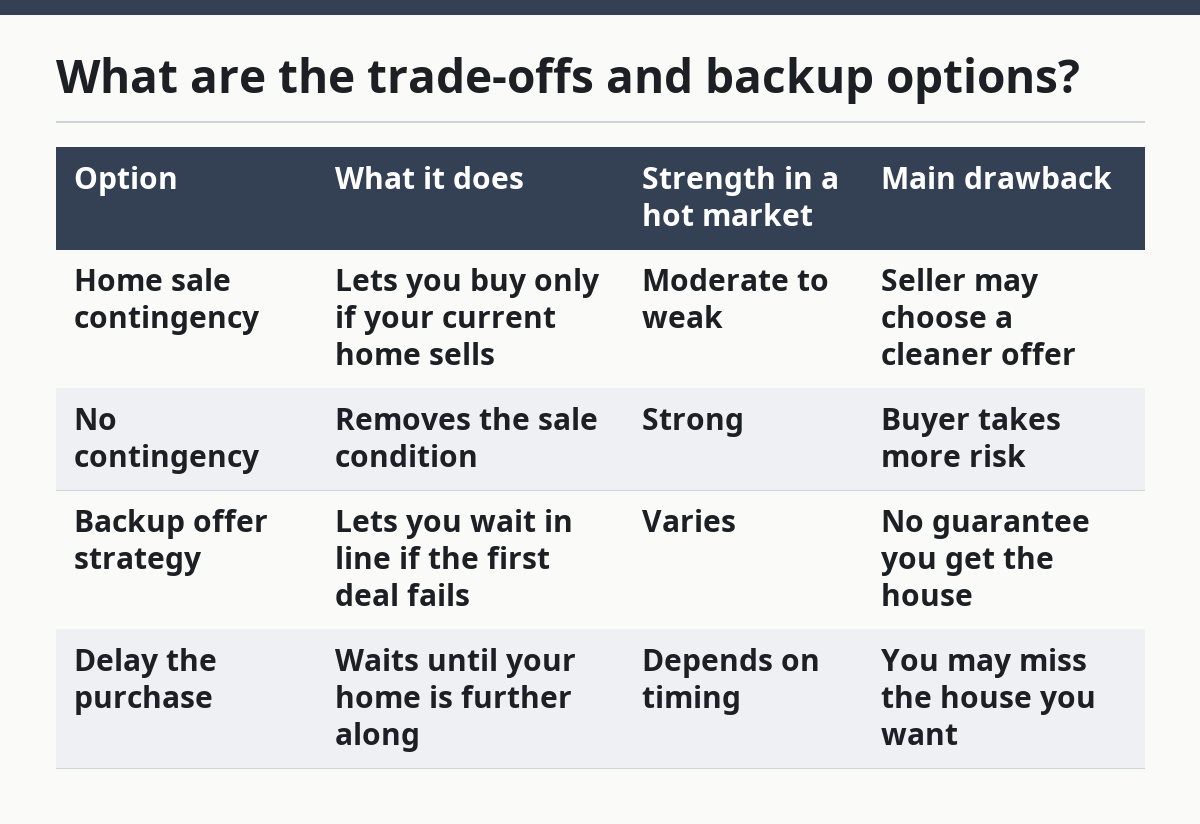
If the contingency hurts your offer, the usual alternatives are not magic. They are compromises. A backup offer may keep you in play without forcing the seller to commit to your timeline. Waiting to buy gives you a cleaner offer later, but you may lose the home now. A no-contingency offer is stronger, but it shifts more risk onto you and can create its own financial strain.
This is the part many generic articles skip: the worst move is often not the contingency itself. It is entering a hot market with a vague plan and hoping the seller will fill in the blanks for you. Sellers do not do that. They pick the offer that feels easiest to close.
Where does this go wrong most often?
It goes wrong when buyers treat the contingency as a formality instead of a signal of risk. In a hot market, a seller reads your offer as a package, not a single sentence. If the sale of your current home is still uncertain, the whole package feels uncertain.
Three mistakes show up often. The first is starting the search before the current home is ready. That can leave you writing offers before you have a realistic closing path. The second is using a long or unclear timeline. A seller faced with a 30-day wait, plus more uncertainty after that, may move on. The third is failing to explain the status of your home in concrete terms. “We plan to list soon” is weak. “The home is listed” or “the home is under contract” carries more weight.
There is also a quieter mistake: assuming every seller will react the same way. Some will accept a home sale contingency if the rest of the offer is clean. Others will not touch it in a multiple offer market. Your real estate agent needs to read the room before you send the offer, not after.
This is the wrong move for a buyer who has not listed their current home, needs a long runway, or cannot tolerate the chance of losing the house. In that case, the contingency may be sensible in theory and still too weak in practice.
What is the best next move?
The best next move is to decide whether your current home is sale-ready enough to support the offer before you tour more houses. If it is, ask your real estate agent to build the contingency around a short timeline, visible progress, and a clear exit plan. If it is not, slow down instead of forcing a bid that a hot-market seller is likely to skip.
That decision point matters because the seller’s side is simple: accept the offer that looks most likely to close. Your job is to make your home sale contingency look like a manageable part of the deal, not a detour that could drag on for weeks. If you can do that, you may still compete. If you cannot, the market may punish the offer before the seller even finishes reading it.
A buyer with a ready home, a sharp agent, and a realistic timeline can still make this work. A buyer with a half-prepared sale and a lot of hope usually cannot.
Drafted with AI; not yet reviewed by a person.