Last updated: November 29, 2026
Quick Answer: 5 changes usually make a home sale contingency offer stronger. The best way to improve a home sale contingency offer is to reduce the seller’s risk, not just raise the price. A cleaner purchase agreement, stronger preapproval letter, more earnest money, a shorter contingency period, and fewer asks for seller concessions all make the offer look likelier to close. If you are also comparing the bigger home sale contingency trade-offs, the goal is to make the home sale contingency offer easier to accept.
Key takeaways
- Sellers worry about delay, not only price, when a buyer has a home sale contingency.
- A sharper preapproval letter and a larger earnest money deposit can make the file look steadier.
- Shortening the contingency window helps only if the listing and your own sale can move quickly.
- Small seller-friendly terms often matter more than one big headline number.
- If your own home is hard to sell, a contingency may still be the right move even if it is not the strongest offer on the table.
What does a seller want to see?
A seller wants proof that your home sale contingency will not stall the closing. In plain terms, the seller wants to know that your current home is likely to sell, that your financing is in place, and that your purchase agreement has fewer escape hatches than the next buyer’s offer. For background on timing and transaction risk, see the CFPB’s guidance on buying a house and the NAR’s home buyers and sellers resources.
That is why a home sale contingency offer gets stronger when the paperwork looks organized and the timeline looks short. A seller usually reads the offer as a risk package, not just a dollar figure. If the buyer looks prepared, the offer can stand out even when it is contingent.
The main levers are simple: stronger earnest money, a solid preapproval letter, a shorter contingency period, and fewer requests for the seller to cover costs. Those changes do not erase the contingency, but they can make the offer feel more dependable.
A generic article often says to “make the offer more competitive” and stops there. That is too vague to help. The real job is to make the seller believe the deal is likely to close on time and with fewer surprises.
What terms make a home sale contingency offer stronger?
A stronger home sale contingency offer uses terms that make the seller’s path to closing feel shorter and clearer. The best terms are the ones that shrink uncertainty in the purchase agreement.
Here is a practical order of operations:
-
Ask your lender for a detailed preapproval letter before you write the offer.
A preapproval letter dated near the offer helps show you are serious and ready. It should be current, not something from months ago that no longer matches your finances or the property price. If you are still comparing options, review what a preapproval letter means before you submit the offer. -
Increase the earnest money deposit if your budget allows it.
More earnest money tells the seller you have more to lose if you walk away without a valid reason. The exact number depends on the deal, so the point is not a magic figure. The point is to signal commitment without putting yourself in a squeeze. -
Shorten the home sale contingency period.
A shorter period gives the seller fewer days in limbo. If your home is already listed and you have a realistic plan, a tighter window can help. For many buyers, the difference between 21 days and 7 or 10 days is the difference between “possible” and “too risky.” -
Keep seller concessions light.
Asking the seller to pay closing costs, repairs, or credits can make a contingent offer feel heavier. If you can cover more of those costs yourself, the offer often looks cleaner. -
Use a simple purchase agreement with fewer extra conditions.
Every extra condition gives the seller one more reason to worry about delay. Keep the offer focused on the home sale contingency and the basics needed to close.
A listing agent will usually read these terms as signs of follow-through. The cleaner the contract, the easier it is for the seller to imagine the closing table. For a deeper comparison, how contingencies work helps explain why a cleaner file often wins.
Should I shorten the contingency period to make the offer stronger?
Yes, shortening the contingency period can make the offer stronger if the timeline is realistic. A 21-day window can look better than a long, open-ended one because it reduces the seller’s wait.
That said, a shorter period is only helpful if your current home can actually move that fast. If the market is slow, the property needs repairs, or you have not listed yet, a tight deadline can backfire. You may end up asking for an extension, and that weakens the offer more than a sensible first draft would have.
The smart move is to match the contingency period to the status of your own sale. If your home is already active with showings, a shorter clock may be worth it. If not, a modest period is safer than pretending the sale will happen in 7 or 10 days when it probably will not.
Sellers dislike uncertainty more than they dislike a fair number. A realistic deadline often beats an aggressive one that has to be changed later.
Can a larger earnest money deposit help with a contingent offer?
Yes, a larger earnest money deposit can help because it shows you have more at stake if the deal falls apart. Earnest money is one of the clearest signals that the buyer intends to close.
This does not mean you should stretch past what you can comfortably risk. A deposit only helps if it is believable and fits the rest of the offer. If the deposit is high but the rest of the file looks shaky, the seller may still see the deal as uncertain.
The best use of earnest money is as part of a larger package. Pair it with a current preapproval letter, a tidy purchase agreement, and a shorter contingency period. That combination gives the seller more confidence than earnest money alone.
A larger deposit is not the right move for every buyer. If your own home sale is uncertain, or if you may need the deposit for another purchase soon after, putting too much cash at risk can make the offer stressful instead of stronger.
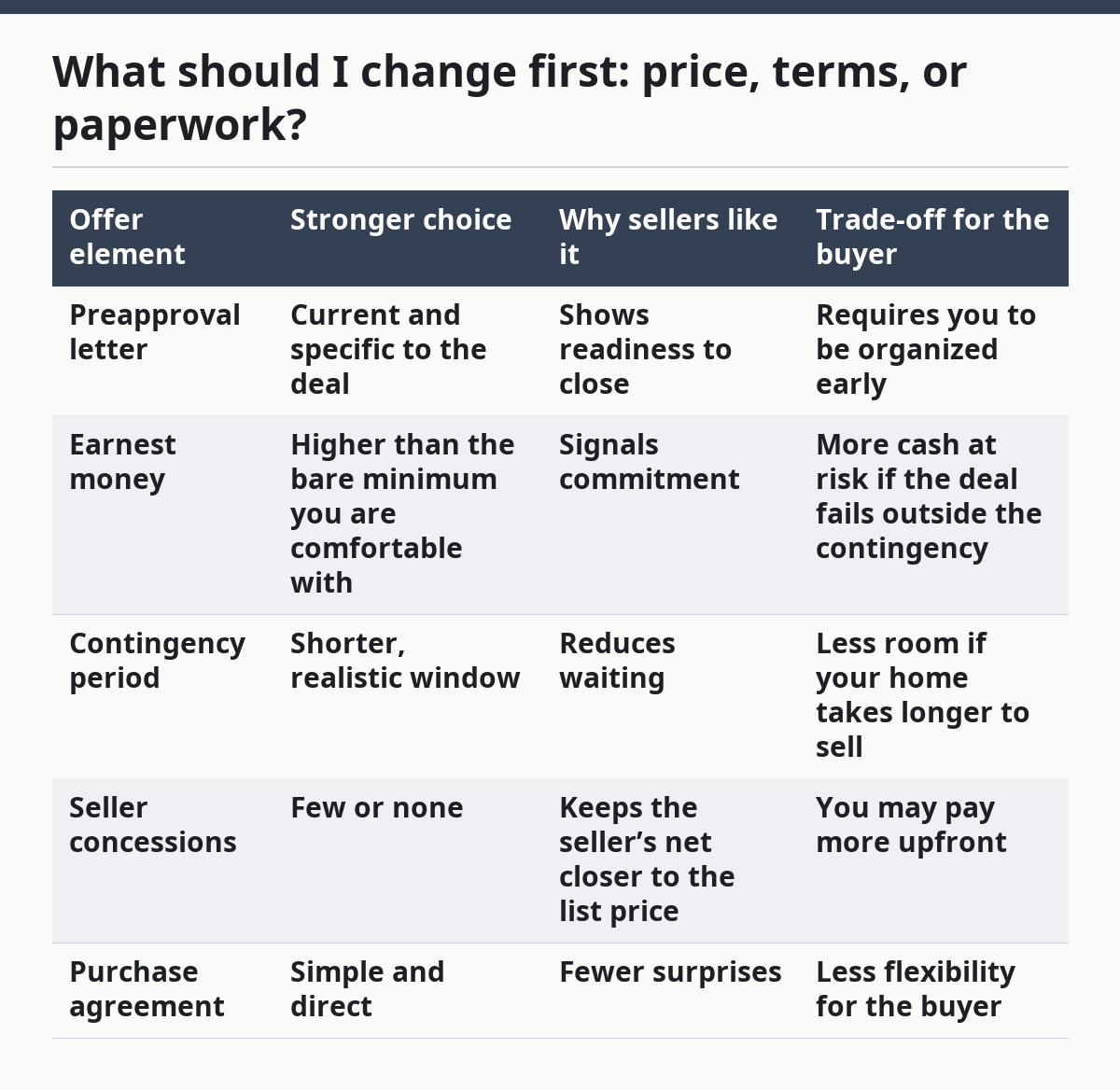
What should I change first: price, terms, or paperwork?
Paperwork should come first, then terms, then price. A seller usually feels the effect of the purchase agreement and supporting documents before thinking deeply about small price changes.
Start with the preapproval letter and the structure of the home sale contingency. Make sure the lender letter is current, the contingency period is short enough to look serious, and the contract does not carry extra asks the seller will dislike. Those changes often matter more than a slightly higher offer price.
Then review the money terms. Earnest money, seller concessions, and repair requests all change how the offer looks from the seller’s side. If two offers are close, the one with fewer deductions and fewer conditions often wins.
Price still matters, but it is not the only signal. A higher price attached to a weak contingency can look less attractive than a slightly lower price with a clean path to closing. That is why listing agents often focus on certainty, not just size. For a broader comparison, see home sale contingency vs. other offer types.
| Offer element | Stronger choice | Why sellers like it | Trade-off for the buyer |
|---|---|---|---|
| Preapproval letter | Current and specific to the deal | Shows readiness to close | Requires you to be organized early |
| Earnest money | Higher than the bare minimum you are comfortable with | Signals commitment | More cash at risk if the deal fails outside the contingency |
| Contingency period | Shorter, realistic window | Reduces waiting | Less room if your home takes longer to sell |
| Seller concessions | Few or none | Keeps the seller’s net closer to the list price | You may pay more upfront |
| Purchase agreement | Simple and direct | Fewer surprises | Less flexibility for the buyer |
What mistakes weaken a home sale contingency offer?
The biggest mistake is making the seller carry too much uncertainty. A long contingency, a thin earnest money deposit, and a weak preapproval letter all tell the seller that closing may be far away.
Another mistake is overasking in the same offer. If the buyer wants a home sale contingency, a long inspection list, closing-cost help, and extra repair credits, the seller may see the offer as too expensive in time and money. Even if the price is good, the overall deal can feel fragile.
A third mistake is using a home sale contingency before your own home is even market-ready. If the property still needs photos, cleanup, or pricing work, the seller may wonder whether your sale will happen at all. That is where the offer can lose force fast.
The fix is not to pretend the contingency does not matter. It is to show the seller a path from contract to closing that looks shorter and less messy. A buyer who trims the extras and presents a clear plan usually looks more reliable than a buyer who throws in one large number and leaves the rest vague.
If you want broader context on how contingencies fit into the larger process, the home sale contingency hub explains the structure of the arrangement and the basic trade-off between buying and selling at the same time.
When is a stronger offer still not enough?
A stronger offer is still not enough when the seller wants speed above all else. If the seller has multiple offers without a contingency, your offer may still lose even after you improve the terms.
It can also fall short if your own home is not market-ready. A buyer who has not listed, priced, or prepared the current home may not be able to promise a realistic timeline, no matter how polished the paperwork looks.
That does not mean the strategy is useless. It means the buyer should judge the situation honestly. A home sale contingency is often the right tool when you need the proceeds from your current home, even if it is not the flashiest offer in the stack.
For a buyer in this position, the goal is not to mimic a cash offer. The goal is to make the deal credible enough that the seller can say yes without feeling trapped.
How does a listing agent read this offer?
A listing agent reads a home sale contingency offer as a balance sheet of risk, time, and proof. The agent looks at the preapproval letter, the earnest money, the deadline, and the purchase agreement details to decide whether the offer is likely to survive.
If the paperwork is tight and the timeline is short, the offer looks easier to recommend. If the offer includes a lot of seller costs or a long open-ended contingency, it can look like a problem waiting to happen.
That is why the strongest version of this offer is usually not the loudest one. It is the one that looks prepared. A buyer who shows clean financing, a realistic sale plan, and fewer demands gives the listing agent less reason to steer the seller elsewhere.
The right question is not “How do I make it perfect?” It is “How do I make this deal feel close to done?” That is the standard sellers respond to.
What terms do sellers like in a contingent offer?
Sellers usually like a contingent offer that feels short, clean, and serious. A current preapproval letter, stronger earnest money, a realistic but shorter contingency period, and limited seller concessions all help the offer look easier to close.
They also tend to prefer a purchase agreement with fewer moving parts. If the contract is simple and the buyer’s current home already has momentum, the seller may see the offer as manageable instead of risky.
Drafted with AI; not yet reviewed by a person.