Last updated: November 19, 2026
Quick Answer: In title insurance vs owner’s policy questions, the answer is usually 2 policies at closing: the lender’s policy protects the loan, and the owner’s policy protects the buyer’s ownership interest. For a home buyer, the owner’s policy is usually the one that matters most because it can pay to defend or fix covered title problems tied to your rights in the property. This is information, not financial advice; for your own situation, a qualified adviser, real estate attorney, or title professional should review the contract and local rules.
Key takeaways
- Title insurance is not one single policy. It usually means 2 different coverages: one for the lender and one for the owner.
- An owner’s policy protects the buyer’s equity and ownership claim, not the mortgage company’s loan.
- Coverage is about past title problems, not future damage or everyday repairs.
- A title search can miss some issues, which is why the policy still matters.
- The rules, forms, and local customs can differ by country, state, or province.
Who does this apply to?

This applies to home buyers who want to understand the 2 policies tied to a closing: the lender’s title policy and the owner’s title policy. It also helps sellers who are trying to read the closing papers or answer a buyer’s question about who pays for what. If the title report already showed a lien, easement, or missing heir issue, the owner’s policy is the part that can matter after closing.
The basic assumption here is simple: a title search has already been done, or will be done, before closing. That search looks for recorded problems in the public record, but it does not remove every risk. The policy is the backup layer, not the search itself.
This topic is high-stakes because title defects can affect legal rights to a house and money tied up in a closing. The usual case is straightforward enough for a buyer to understand, but if the deed is in a trust, the seller is in probate, or the property has an old boundary dispute, the paper trail can get messy fast. In those cases, a qualified professional should read the file before anyone relies on a general explanation.
What does title insurance cover?
Title insurance covers certain past problems with ownership records, liens, and other defects that existed before the policy date. It usually pays for covered legal defense costs and covered losses if a listed title problem later shows up and threatens the insured interest.
A good way to think about it is this: the policy protects against defects in the title, not damage to the house. A roof leak, a broken furnace, or a flood claim belongs to property or hazard insurance, not title insurance.
Covered issues often include things like a prior owner’s unpaid lien, a forged signature in the chain of title, an undisclosed heir, or a recording mistake. The exact list depends on the policy form and the local rules in force where the property is located. In the United States, the Consumer Financial Protection Bureau explains the role of title insurance in home closing paperwork, and the American Land Title Association publishes common policy forms used in the market.
Sources: CFPB on title insurance and ALTA consumer resources.
What does an owner’s policy cover?

An owner’s policy covers the buyer’s ownership interest in the home, which is why it is the policy that matters most to a purchaser. If a covered title defect appears after closing, the owner’s policy is the one that can help with the cost of defending the title or paying a covered loss.
That coverage is usually based on the purchase price or insured amount stated in the policy, and it lasts as long as the insured owner or eligible heirs have that covered interest, subject to the policy terms. It is not a maintenance contract, and it does not protect against a drop in market value from ordinary market changes.
This is the piece many first-time buyers miss. The lender’s policy protects the mortgage lender’s lien, not the buyer’s equity. If the buyer never gets an owner’s policy, the loan can still be covered while the buyer’s own interest is not.
How are title insurance and an owner’s policy different?
Title insurance is the category; the owner’s policy is one type inside that category. The lender’s policy and the owner’s policy can be issued in the same closing, but they protect different parties and have different consequences if a claim happens later.
| Feature | Title insurance, overall | Owner’s policy |
|---|---|---|
| What it is | The general type of insurance tied to title defects | The policy for the buyer’s ownership interest |
| Who it protects | Either the lender, the buyer, or both, depending on the policy | The homeowner or other named owner |
| Main risk covered | Past title defects in the public record or chain of title | The buyer’s loss from a covered title defect |
| Typical focus | Clearing or defending title issues before and after closing | Preserving the owner’s rights after closing |
| What it does not cover | Normal property damage or future market swings | Those same non-title risks |
| Common companion policy | Owner’s policy | Lender’s policy often appears beside it |
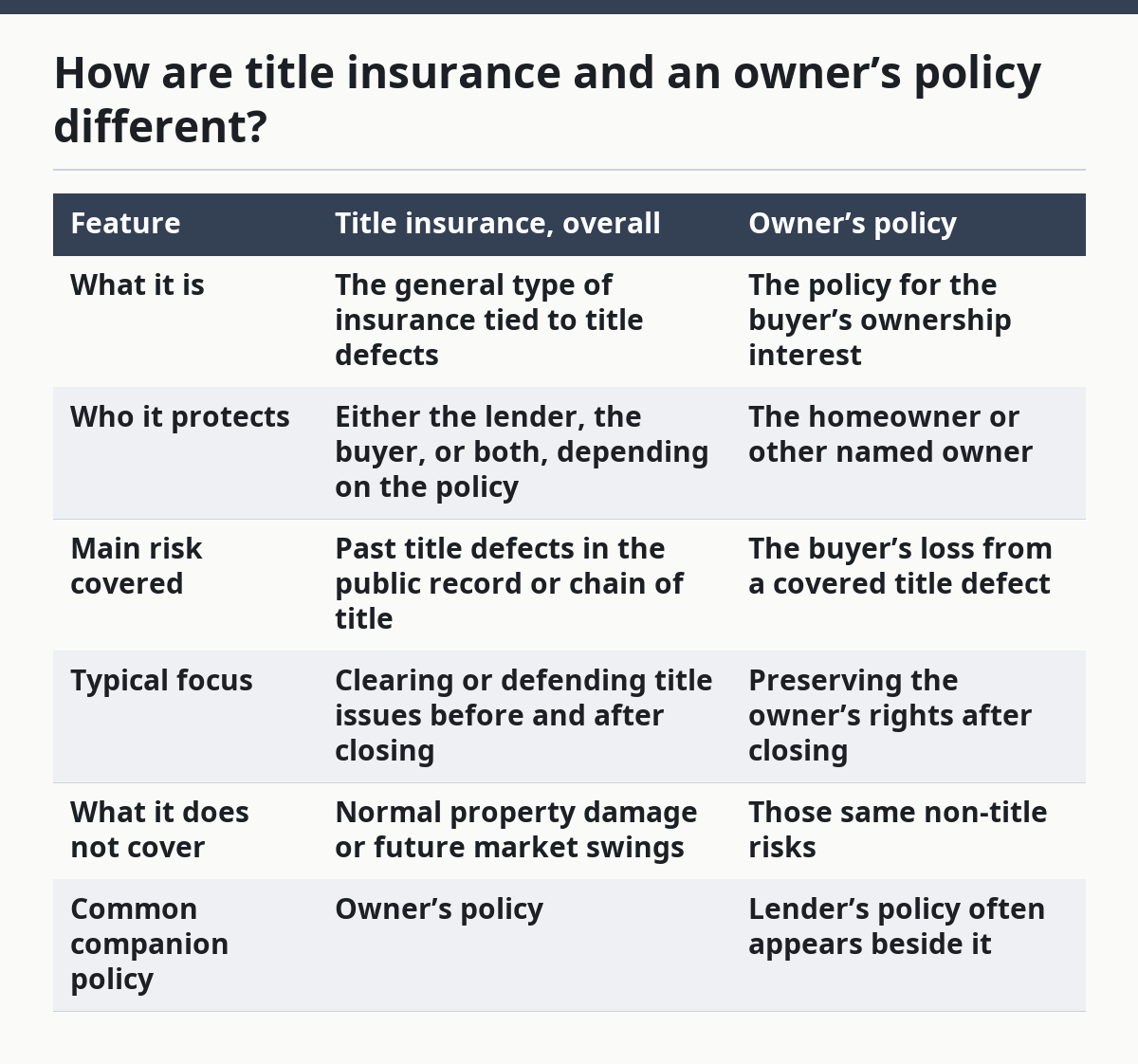
The biggest practical difference is who gets paid if trouble appears later. A lender’s policy helps protect the loan balance. An owner’s policy helps protect the person who actually bought the home and put cash into the deal.
What is not covered?
Title insurance does not cover every problem that can affect a home, and that gap is where many buyers get surprised. It is designed for title defects, not for 3 common household risks: wear and tear, natural damage, and market loss.
A policy usually will not cover a clogged drain, a cracked foundation from soil movement, or a stolen appliance. It also usually will not cover issues that were created after the policy date, such as a new lien caused by the owner’s later unpaid work or taxes, depending on the local system and policy terms.
There is another limit that matters: many title policies exclude matters the buyer agreed to accept, matters shown in the public record, or matters that a survey would reveal if no survey was ordered. That is why a title policy and a survey are not the same thing. One looks at legal record risk; the other can show physical boundary clues.
How does a claim usually work?
A title claim usually starts when a covered defect surfaces and the owner notifies the insurer under the policy terms. The insurer then reviews the policy language, the title record, and the claim facts to see whether the issue is covered and what remedy fits.
The remedy can be legal defense, a payment for covered loss, or action to clear the title problem. The policy does not automatically erase the issue in every case, and the outcome depends on the defect, the policy, and the local law.
A simple example: if a prior lien was missed and later enforced, the insurer may step in if the lien falls within the policy’s coverage and exclusions do not apply. If the problem came from a new contract signed after closing, the policy usually is not the fix. That difference is why the policy date matters so much.
When should you slow down and get qualified help?
You should slow down when the title file is not routine, because 1 wrong assumption can change who owns the right to sell or live in the property. These are the situations where general reading stops being enough:
A probate estate is involved: The seller may not yet have full authority to transfer title — Ask for the closing file to be reviewed before signing anything.
The property was inherited or transferred through a trust: The chain of ownership can be longer than it looks — Check that the deed and authority documents line up.
A lien, judgment, or tax issue appears on the search: A recorded debt can survive the sale if it is not handled correctly — Get the payoff or release terms confirmed in writing.
The survey shows a boundary or easement issue: A 10-foot strip, shared driveway, or access path can change the value of the land — Review the survey and policy exceptions together.
The closing statement names a policy but not the insured amount: Missing details can affect the protection that is actually issued — Make sure the policy type and coverage amount match the transaction documents.
The buyer is using a home sale contingency with timing pressure: Tight deadlines can hide title problems until the last minute — Build in time for the title review before the contingency expires.
What mistakes do buyers make?
The most common mistake is confusing the lender’s policy with protection for the buyer. That can leave a homeowner thinking they are covered when only the bank is covered. The fix is to check whether the policy being discussed is the owner’s policy or the lender’s policy.
Another mistake is skipping the owner’s policy to save money at closing. That can look small on the settlement sheet and become expensive if a covered title defect shows up later. The right alternative is to understand exactly what risk is being passed on and whether the policy form covers the buyer’s interest.
A third mistake is assuming a clean title search means no future issue. A search can miss forged documents, unrecorded heirs, or filing errors. The policy exists because a record search is not perfect.
A fourth mistake is treating title insurance like homeowners insurance. If you are unsure, ask a title professional or real estate attorney, because the 2 products cover different risks. One is about ownership defects in the record; the other is about physical loss, liability, and damage to the property.
A fifth mistake is ignoring policy exceptions that are printed in the commitment or final policy. Those exceptions can narrow what is covered, especially where a survey was not provided or a legal description is uncertain. The safer habit is to read the exceptions before closing, not after.
FAQ
Is title insurance the same as an owner’s policy?
No. Title insurance is the broad category, and an owner’s policy is the policy that protects the buyer’s ownership interest. The lender’s policy protects the mortgage lender instead, so the 2 policies serve different people.
Do I need both a lender’s policy and an owner’s policy?
They are separate policies with separate jobs. If there is a mortgage, the lender will usually require its own policy, while the owner’s policy protects the buyer’s side of the deal. The details can vary by local practice and contract terms.
What does an owner’s policy not cover?
An owner’s policy usually does not cover house damage, repairs, flood loss, or a drop in market value. It is aimed at covered title defects, such as certain liens, record errors, or ownership claims that existed before closing.
If the title search is clean, why keep the policy?
A clean search lowers the chance of trouble, but it does not remove every title risk. The policy is there for the problem the search did not catch, including some errors, omissions, or hidden claims that surface after closing.
Does title insurance work the same everywhere?
No. Country, state, and provincial rules can change the forms, wording, and process. A buyer should check the local closing practice and the actual policy language, not assume one market works like another.
Drafted with AI; not yet reviewed by a person.